Legal partner behind the builders of tomorrow. Mission

Subscription Compliance by Design: How to Build a Transparent Subscription Flow in B2C Digital Products
Summary: Subscriptions can be a strong revenue model for digital businesses. This article sets out a practical checklist for B2C digital products using subscriptions, free trials, auto-renewals, or recurring billing facing the US, the UK, and EU markets. It covers pricing disclosures, consent, trial rollovers, renewal reminders, cancellation flows, and app store requirements.
Authors:

Valeriia Sych
Junior Associate

Why Subscription Compliance Starts With Product Design
Subscriptions are now a core part of the digital economy. B2C SaaS products, AI tools, mobile apps, creator tools, streaming platforms, fitness and wellness apps, and e-commerce membership programs often rely on recurring payments. The model itself is useful, lawful, and commercially strong.
The compliance challenge is that subscription flows involve many moving parts. A compliant subscription journey depends on checkout wording, pricing presentation, consent collection, billing logic, free trial auto renewal flows, renewal reminders, cancellation routes, and payment provider requirements. It is easy to miss one of these steps, even for a legitimate business. The result may be complaints, refund requests, chargebacks, or regulatory scrutiny.
This article focuses on B2C subscription compliance. B2B subscription arrangements may raise their own issues, but they usually involve more sophisticated counterparties, and negotiated terms.
The recent Federal Trade Commission action against the Genesis Tech enterprise is a useful reminder of this risk. The FTC, which is the US authority responsible for consumer protection, alleged that Genesis marketed products as free or available for a low, one-time cost, obscured recurring charges, and added products without proper consent. The case is ongoing, and it will be important to follow how the court assesses these practices.
For businesses building subscriptions in good faith, the lesson is that subscription compliance should be considered at the product design stage. In our work with consumer-facing digital businesses, we often see strong products where the subscription logic, checkout wording, or cancellation journey has not been fully aligned with consumer protection expectations of regulators. We help fix that.
However, legal requirements are only one layer of subscription compliance. Many B2C digital products are distributed through app stores or paid for by card, which means the business may also need to comply with Apple App Store, Google Play, merchant, Visa, Mastercard, and payment processor requirements.
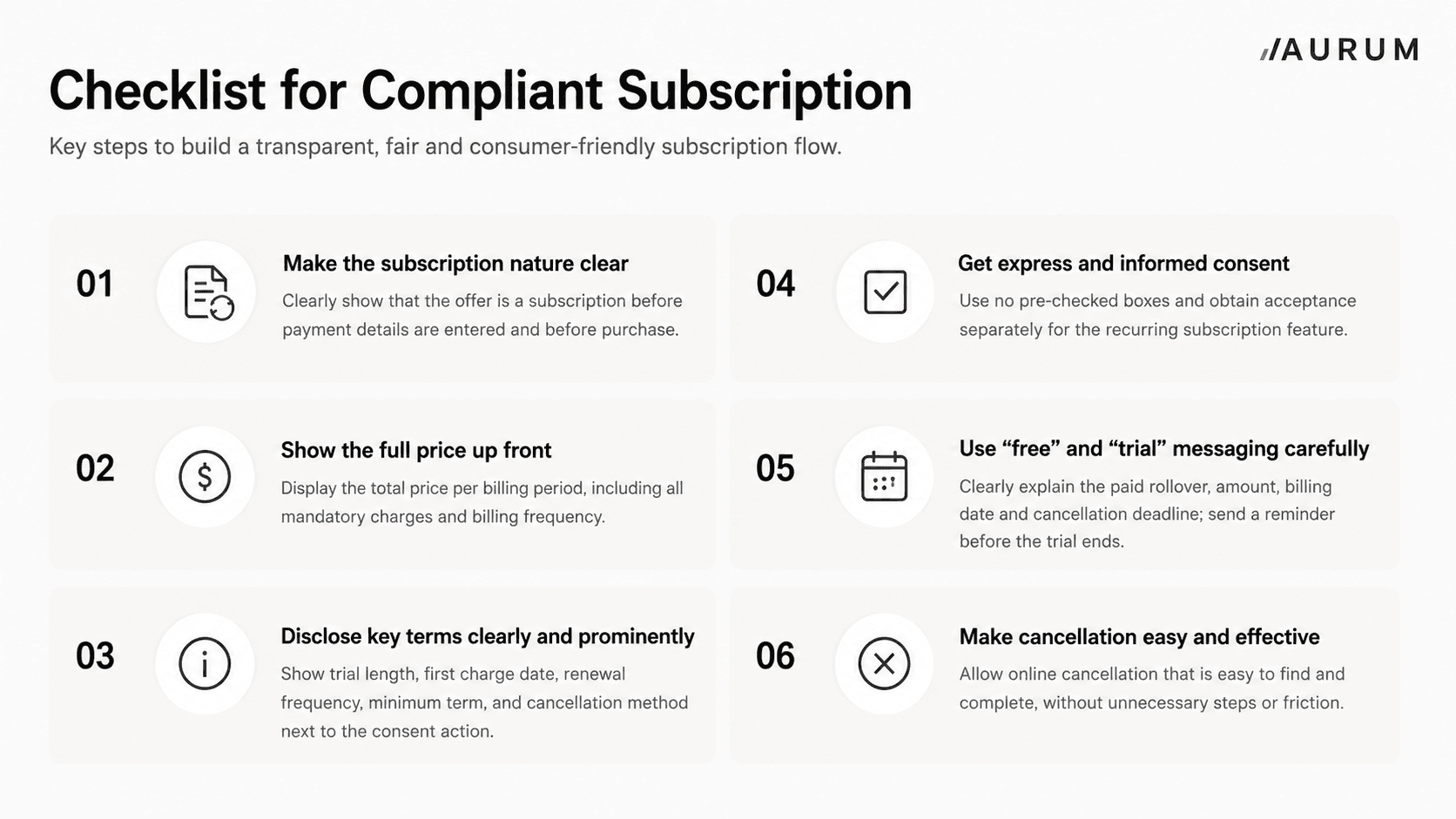
The checklist below is intended as a practical starting point for teams that are launching a subscription or reviewing an existing recurring billing model. It is not exhaustive and does not replace legal advice. Subscription requirements can differ significantly by jurisdiction.
1. Make It Clear That the User Is Buying a Subscription
The first checkpoint is to make it clear that the offer is a subscription, not a one-time purchase. If a user is entering a recurring payment arrangement, this should be visible before payment details are entered and before the user clicks the final purchase button. The recurring nature of the contract should not be hidden in a footer, a small, barely visible disclosure, or a general Terms and Conditions link.
If the main commercial message says “free”, “trial”, “only $1”, or “start now”, the same screen should clearly explain what happens after the trial or introductory price ends. For B2C subscription compliance, the user should understand from the interface itself that the product will renew or continue unless cancelled.
2. Show the Full Subscription Price Upfront
The second checkpoint is price transparency. The user should understand the full cost of the subscription before committing. This includes the price per billing period, the billing frequency, any minimum term, any activation fee, and any mandatory additional charges.
As the UK Competition and Markets Authority recommends, show the total price the customer will pay each month, being the full price, including any mandatory charges the customer will pay during that period.
Clear price presentation is also important for recurring billing compliance. If the customer will be charged monthly, annually, or after an introductory period, the amount and timing of the future charge should be easy to see before consent is given.
3. Disclose Key Subscription Terms Before Consent
The third checkpoint is clear disclosure of material terms. A subscription flow should clearly explain the trial length, the date of the first paid charge, the renewal frequency, the minimum term, the cancellation deadline, and the cancellation method.
These are the core commercial terms that affect the customer’s decision to subscribe. Presenting them in a dense legal block is usually not enough. Disclosures should appear close to the action by which the consumer gives consent, be understandable to ordinary consumers, and not require the consumer to click a hyperlink, open another tab, or hover over an icon to understand the main subscription terms.
For digital product teams, this means that the key subscription terms should be part of the checkout design, not only part of the legal documentation. The user should be able to understand the essential terms at the moment they decide whether to start the subscription.
4. Obtain Express Consent to Recurring Charges
The fourth checkpoint is express and informed consent. A seller should obtain the consumer’s acceptance of the subscription feature separately from other parts of the transaction, if any.
A pre-checked box should not be treated as affirmative consent, and the interface should not include information or design elements that interfere with, distract from, contradict, or otherwise undermine the consumer’s ability to give informed consent.
Where the business relies on the consumer’s card details for future recurring charges, it should be able to verify that the consumer understood and accepted that specific recurring feature. Consent to a one-time purchase should not be treated as consent to a separate subscription, auto renewal, or recurring billing arrangement.
This is especially important for AI tools, SaaS platforms, and mobile apps where the user may enter card details quickly during onboarding. The subscription feature should be accepted clearly, not inferred from silence, default settings, or continued use.
5. Make Free Trials and Paid Rollovers Clear
The fifth checkpoint is careful use of “free” and “trial” messaging. Free trials are not inherently unlawful, but they are high risk when the paid rollover is unclear. If the user will be charged automatically after the trial, that fact should be prominent. The same applies to the amount, the billing date, and the cancellation deadline.
It is good practice for the seller to contact the customer shortly before the end of the free trial with a brief reminder that, starting from a specific date, for example, 5 July, the customer will be charged monthly. In some jurisdictions, such as the UK, this is not merely good practice, but a legal requirement.
For B2C digital products, this checkpoint is particularly important because free trials are often used in growth funnels. The trial can be an effective acquisition tool, but the customer should understand exactly when the free period ends and what happens next.
6. Make Online Cancellation Easy to Find and Complete
The sixth checkpoint is cancellation. Regulators are increasingly sceptical of flows that make sign up simple but cancellation difficult. If a consumer subscribed online, they should normally be able to cancel online. If they subscribed in an app, cancellation should not require a phone call, a support ticket, or a search through hidden account settings. The cancellation path should be easy to find and easy to complete.
A cancellation flow that requires the consumer to pass through multiple discount screens, answer unnecessary questions, or repeatedly confirm the same decision can look like artificial friction. The safer approach is to allow cancellation first, and only present optional offers in a way that does not delay or obscure the exit.
Subscription cancellation requirements should be reviewed together with the product interface, customer support process, billing provider settings, and app store cancellation route. A clear cancellation button in the interface is not enough if billing continues, or support agents apply inconsistent rules.
Building Subscription Flows Around Informed Choice
The main subscription risks usually sit in product design, pricing presentation, checkout flows, billing logic, renewal communications, and cancellation architecture.
A defensible subscription journey should be reviewed end-to-end. The business should ask whether the user understands that the product is recurring, sees the full price, gives active consent, receives appropriate reminders, and can cancel without unnecessary effort. The answer should be visible from the interface itself, not buried in internal policies.
Regulators are targeting opaque design, inertia-based consent, surprise renewals, and artificial retention. App stores and payment providers are also focused on reducing customer confusion, failed cancellations, and avoidable disputes. Businesses that design subscriptions around informed choice are better placed to reduce complaints, chargebacks, refund disputes, app store escalation, payment issues, and enforcement risk.
How Aurum Can Assist
Aurum advises teams building software, product-led companies, and e-commerce platforms. We help assess and improve subscription flows, checkout design, and pricing disclosures, draft user-facing documentation, including Terms and Conditions and privacy documents, and help reduce legal risk across the full customer lifecycle.
Related publications

Can Developers Use AI Coding Tools Safely? Legal Risks and Controls for Software Companies
Valeriia Sych
Junior Associate

Blockchain Compliance by Design: Smart Contract Controls for Regulated Crypto Flows

Tetiana Kontariova
Associate

DeFi Interface Regulation: Building a Compliant Frontend. Legal Risks & Compliance Checklist

Partner

LinkedIn Marketing Legal Checklist: What Businesses Should Check Before Launching a Campaign
Tetiana Kontariova
Associate