Legal partner behind the builders of tomorrow. Mission

How AI Agents Are Changing the Production of Legal Work at Aurum
Summary: Pavel Batishchev of Aurum shares how specialised AI agents are changing the way complex legal work is produced – from first drafts and source verification to matter memory, document automation and senior lawyer review.
Authors:

Managing partner
Introduction – The Confusing Part of “AI for Lawyers”
Most lawyers I know now use AI in some form. They use it for research, language polishing, internal notes, first-pass drafting, document review, and many other routine tasks. At Aurum, we have done the same for the last three years.
But for a long time, the underlying legal workflow did not really change.
Take a large structuring project. We would assemble the team, divide research streams, discuss the structure, prepare a long memorandum, review it internally, and then send the final product to the client. AI helped at different stages — research, drafting, polishing, summarising — but the process remained recognisably the same. The lawyer still moved the matter from one traditional step to another. AI made parts of the work faster, but it did not fundamentally redesign the workflow.
The real change came with AI agents. By an agent, I do not mean a generic model with a legal prompt. I mean a specialised system with active memory, domain knowledge, practical skills, templates, source-verification rules, document tools and matter context.
In a legal environment, a good agent is closer to a supervised junior practice system than to a chatbot or a database. It does not replace the senior lawyer’s judgment. But it can take over structured parts of the legal process, keep context across tasks, work with documents, check sources, and move a matter forward under supervision.
A Real Example From a Structuring Matter
Recently, we were asked to structure a private placement of synthetic tokenised exposure to capital markets products. One year ago, we would have started by assembling lawyers with different specialisations: securities and financial products, regulatory compliance, corporate structuring, tax reporting, CRS/FATCA and tokenisation. The first deliverable would probably have been a 30 to 50 page client memorandum with annexes, product specifications, investor eligibility criteria and a risk matrix. A good first draft could easily have taken two or three weeks before the senior legal team performed final review.
That process is now reversed.
The old model was linear: research, first draft, internal review, partner review, client delivery. The new model is more iterative.
Now the senior lawyer starts with the specialised agent, frames the matter with the agent first. The agent creates the first structured surface. Specialists then review targeted parts of the work. The result is not less lawyer involvement. It is lawyer involvement at a better point in the process.
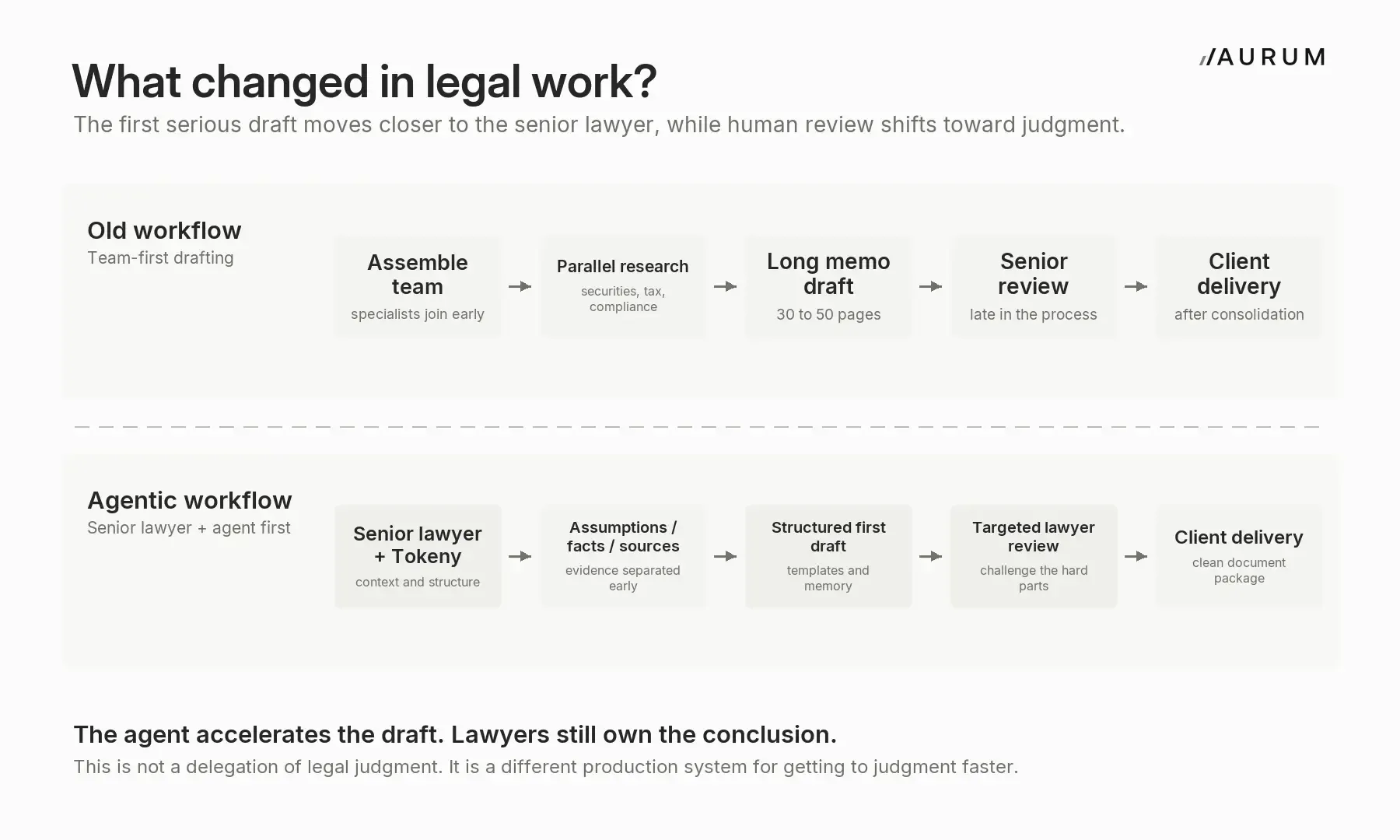
The Workflow Has Reversed: Senior Lawyer First, Agents, Wider Team
The project lead gives the agent the matter context, background documents, candidate templates, intended delivery format and any prior matters or solutions that may be relevant. The agent reads its own operating rules, the knowledge base, the specific workflow and the documents identified by the lawyer. It then begins with assumptions, missing facts and the proposed structure of the work.
The first draft arrives much faster because the agent does not start from a blank page. It starts from our accumulated practice: prior structures, checked language, source hierarchy, document allocation patterns and known failure modes. In a mature workflow, work that previously required weeks to reach a solid first-draft stage can sometimes reach an internal review-ready stage in less than an hour. That does not mean the work is finished. It means a serious basis for legal judgment appears much earlier.
Only after that first surface exists do we usually bring in the wider lawyer team. This is the opposite of the old model. Before, junior lawyers and specialists helped create the first draft and the senior lawyer reviewed at the end. Now the senior lawyer and the agent build the first structured draft, then the relevant lawyers review, challenge and improve specific parts of it. Human review has not disappeared. It has moved to a better point in the process.
Tokeny: A Firm-Specific Legal Agent
For this type of matter we used Tokeny, our tokenisation and digital securities agent. The name is a small personal nod to Tokeny, one of the early tokenisation platforms from Luxembourg I came across in 2018. Internally, Tokeny is not a magic box and not a replacement for an associate. It is a counsel-support system built around our own practice memory
In practical terms, Tokeny is a controlled working environment for a recurring category of legal work. It knows how we structure these matters, which sources matter, what assumptions usually fail, what documents are typically needed, and how the output should be prepared for lawyer review.
Tokeny has a domain wiki, personal and matter memory, structuring rules, templates and delivery skills. Before moving into a client-facing draft, it first makes a map of the matter: what we are assuming, which facts are confirmed, which legal sources support the analysis, where the risks sit, which structures are realistically available, and which questions still need a human answer. These working files force the work to separate verified law, official guidance, verified fact, client assertion, inference and market practice.
To make this less abstract, as of June 4, 2026 Tokeny’s working surface includes 92 files in its domain wiki, 11 human-facing skills and procedures, subordinate agents for narrow delivery workflows, 34 template and precedent files, 25 helper scripts and roughly 112,000 words of compiled wiki knowledge. Some subordinate agents are built for very specific jobs, such as EEA prospectus drafting or fund-linked note documentation. The broader skills and precedent corpus is larger: more than 400 Markdown files and about 575,000 words, including section-level prospectus, risk-factor and clause material extracted into machine-usable form.
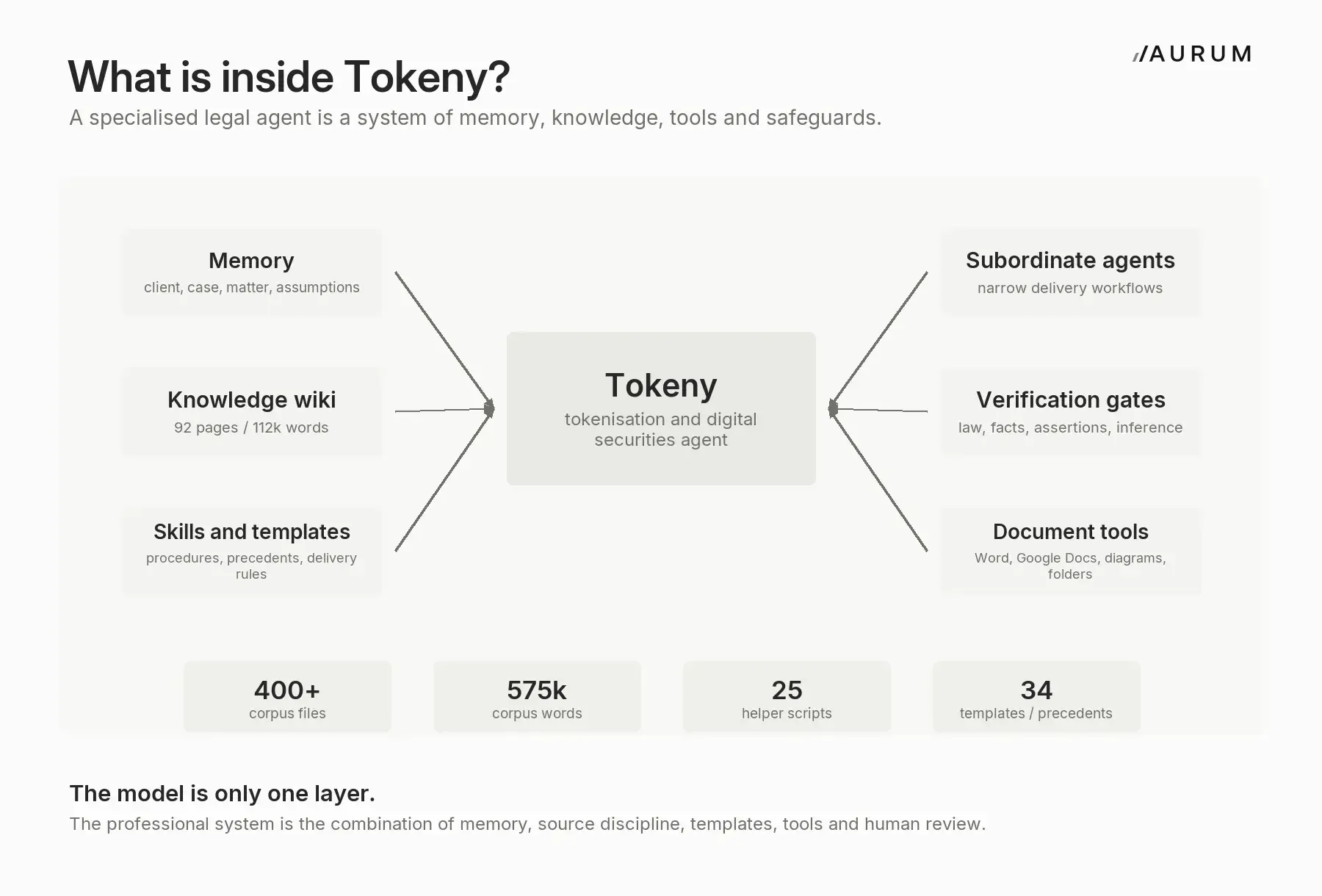
Even so, Tokeny is still young and relatively small. We treat it as a first version of what this operating model can become.
The Boring Tools Are Part of the Intelligence
A surprising amount of legal AI discussion focuses on reasoning and ignores delivery. But legal work is not just analysis. It is also documents, version control, formatting, tables, annexes, diagrams, source lists, matter folders and memory.
We found that it is difficult to make a language model consistently produce a document in the form a law firm actually needs. So we built tools around the agents. A large Markdown memorandum can be exported into a formatted Word document or Google Doc that follows Aurum standards, with proper headings, numbering, tables and embedded diagrams. Structure charts can be generated in a consistent Aurum visual style. Matter folders can be created and organised automatically. Work products, intake documents, logs, assumptions and open questions live in the right place without the lawyer manually moving files around.
This looks ordinary from the outside. Internally, it saves a large amount of time because it removes the friction that usually sits between legal thinking and client-ready delivery.
Memory Is the Difference Between a Chatbot and a Legal System
The most important element is memory. We use different layers of memory for the agent, the client, the case, the matter and the individual task. The system keeps logs of work done, decisions made, assumptions, open issues, sources checked and feedback received from lawyers. After a step is complete, the agent can update the relevant memory automatically.
No CRM we used before gave us this richness of context. The problem with traditional systems was never only functionality. It was the burden of keeping them updated. If lawyers must write long internal reports after every step, the system will decay. With agents, memory capture becomes part of the work itself.
A lawyer joining a project can quickly understand the reasoning path, not just see a folder of documents. A matter that paused for six months can be resumed with its assumptions, concerns, decisions and unresolved questions intact. That continuity is one of the real advantages of agentic legal work.
Hallucinations Are a Process Problem
I am often surprised by how often hallucinations still appear as a recurring problem in legal AI work. We often see news reports about lawyers and reputable law firms citing non-existent or wrong legal materials. In practice, this is not an unsolvable problem. It can be addressed technically and procedurally if the system is built to verify sources before the output is treated as legal work.
For legal work, the agent should not be allowed to treat a secondary article, an inference or a client assertion as verified law. It should reopen primary sources where a legal proposition matters, identify the jurisdiction and legal instrument, check whether a statement is still current, and mark what remains uncertain. Before delivery, it should also inventory and audit the claims made in the document, then verify the claims that matter for the conclusion. A client-facing conclusion is not complete unless the system can identify what is verified law, what is verified fact, what is still only a client assertion, what is inference, what is market practice and what an opposing lawyer or regulator would attack first.
This does not make the system infallible. It makes the error surface visible enough for lawyers to review it.
Why Serious Legal Agents Must Be Built, Reviewed and Calibrated
We now spend significant time developing the agents. Aurum has over twenty named agents, legal and non-legal, covering areas such as corporate structuring, tokenisation, ML/TF compliance, tax reporting, IP, asset management and funds, jurisdiction-specific regulation, business strategy, accounting, design, content and platform architecture.
One more example of agents we have developed is the contract review agent behind ai.aurum.law. It is a narrow Crosby-style agentic workflow built for one recurring job: commercial contract review. For each client, this type of agent can be adapted around the client’s contract flow, internal playbook, risk appetite, negotiation positions and preferred form of deliverable.
The agent is capable of reviewing contracts against a checklist and framework tailored to a specific client, or task. It can identify deviations from predefined requirements, flag issues requiring attention and escalate novel, unusual or non-standard situations to the legal team for further assessment. The final review, professional judgment and delivery always remain with the supervising lawyer.
To be honest, making all of this work and delivering it in practice is quite complex. More importantly, it takes time to develop, set up, calibrate and populate the agent with the necessary knowledge, skills, safeguards and testing routines needed to produce repeatable quality. Lawyers also need to review the agent’s documentation line by line and keep amending it as the work develops. This is also why I am cautious about generic shared libraries of AI agents. If you have not reviewed the agent’s instructions, memory, tools, source hierarchy, safeguards and delivery rules, you do not really know what professional system you are relying on.
For serious legal work, the agent should carry the firm’s own context and the firm’s own discipline. Otherwise it is just another external tool with an impressive interface.
Will AI Replace Lawyers?
I do not think so. In complex matters, the agent is not suitable as a replacement for the lawyer. It helps organise evidence, prepare drafts, check sources, compare structures, remember decisions and produce documents. The lawyer remains responsible for framing the problem, choosing the structure, challenging the analysis and approving the final advice. In practice, AI lets lawyers do more of the work that matters. Less time is spent on routine drafting, formatting, document assembly and reconstructing old context. More time is spent on structure, risk, judgment, client strategy and the points where law is genuinely uncertain.
Conclusion
AI is not killing the legal profession. It is changing the production system around legal work. Building reliable AI agents takes months, and repeatable quality is much harder than a good demo. But once the system has memory, tools, verification routines, templates and human review, it can compress the time spent on legal work dramatically and let lawyers focus on the part of the job that still matters most: judgment.
Related publications

Can Developers Use AI Coding Tools Safely? Legal Risks and Controls for Software Companies

Valeriia Sych
Junior Associate

Blockchain Compliance by Design: Smart Contract Controls for Regulated Crypto Flows

Tetiana Kontariova
Associate

DeFi Interface Regulation: Building a Compliant Frontend. Legal Risks & Compliance Checklist

Partner

Subscription Compliance by Design: How to Build a Transparent Subscription Flow in B2C Digital Products
Valeriia Sych
Junior Associate